
Why Do I Wake Up at 3 A.M.? The 3 A.M. Rule Behind Ghost Stories
Why do I wake up at 3 a.m.? The devil's hour folklore, the real science of sleep cycles and cortisol, and why ghost stories love this hour.
 By Horror Jungle17 min read
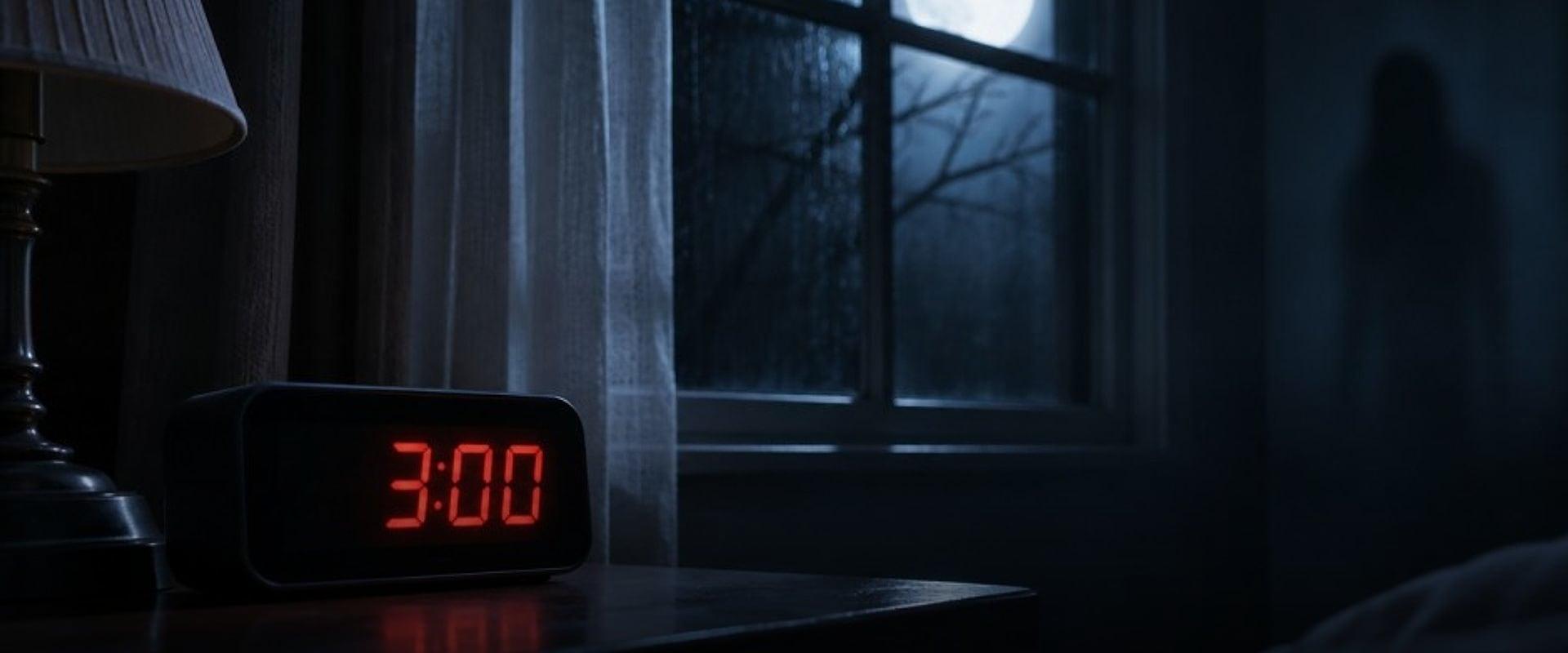
You open your eyes. The room is dark. You check the clock.
3:00 a.m.
Again.
No alarm. No noise. Nothing woke you. You are just suddenly, completely awake, and the house is so quiet you can hear your own heartbeat. You don't want to look at the doorway. You look anyway.
If this has happened to you, you are not alone. Search online and you will find thousands of people asking the same question: why do I wake up at 3 a.m.? On Reddit's paranormal and sleep forums, it is one of the most repeated stories there is. Some people are sure it means something spiritual. Ghost hunters call it the witching hour, or the devil's hour. Horror movies have been using it for decades.
So what is really going on?
The short answer: around 3 a.m., your body is naturally in its lightest, most dream-filled sleep, your temperature is near its lowest, and your wake-up hormone cortisol is starting to rise. That makes brief awakenings at this hour very common. And because the world is silent and your brain is half-dreaming, those awakenings feel eerie, which is exactly why ghost stories cluster around them.
But the full story is much more interesting than that. It involves a Shakespeare quote, a lost way of sleeping that humans practised for thousands of years, a nightmare condition that makes people see figures in their bedroom, and a Harvard theory about why your brain turns dark after midnight.
Let's stay up and find out.
Part 1: The folklore. Where did the "devil's hour" come from?
The witching hour started at midnight
The original witching hour was not 3 a.m. at all. It was midnight. In folklore, it was the moment when witches, ghosts and demons were thought to be at their most powerful, as Britannica explains. Shakespeare made the idea famous in Hamlet (around 1600), when Hamlet says: "'Tis now the very witching time of night, when churchyards yawn and hell itself breathes out contagion to this world."
So how did 3 a.m. take over?
The 3 a.m. idea comes mainly from Christian tradition. According to the Gospels, Jesus died at "the ninth hour", which is about 3 p.m. Over time, some believers came to see 3 a.m., its exact opposite, as an hour when evil mocks that moment. That is why 3 a.m. is often called the devil's hour.
There is a second layer too. In Christianity, the number three stands for the Holy Trinity. Demonologists, including the real-life ghost hunters Ed and Lorraine Warren whose cases inspired The Conjuring, often claimed that demons act in threes, such as three knocks or three scratches, as a mockery of it.
You may also read online that Pope Pius IV invented the term "witching hour" in 1560. This claim is repeated on many websites, but we could not find any solid historical source for it, so treat it as a modern myth.
It's not just a Western idea
Many cultures have a special, dangerous or sacred hour in the dark before dawn.
| Culture | The hour | What people believe |
|---|---|---|
| Western Christian folklore | 3 a.m. to 4 a.m. | The devil's hour, an inversion of Christ's 3 p.m. death; demons and ghosts are strongest |
| Old European folklore | Midnight | The witching hour, when spells and spirits are most powerful |
| Japan | Ushi mitsu doki, roughly 2 a.m. to 2:30 a.m. | The "hour of the ox", when ghosts and curses are most active |
| India (Hindu tradition) | Brahma muhurta, roughly the 90 minutes before sunrise | The opposite: a holy, peaceful time for prayer and meditation |
| Modern paranormal community | 3 a.m. to 4 a.m. | The "veil" between our world and the spirit world is thinnest |
Notice something? Across the world, people treated the deep, dark hours before sunrise as special. Some saw danger. Some saw holiness. Almost nobody saw it as an ordinary hour. And as we are about to see, there may be a reason our ancestors felt that way.
How horror movies turned 3 a.m. into a trap
Horror filmmakers love this hour, especially in supernatural horror, and once you notice it, you will see it everywhere.
| Movie or show | The 3 a.m. moment | Why it matters |
|---|---|---|
| The Amityville Horror (1979, remade 2005) | George Lutz keeps waking at 3:15 a.m. | The real DeFeo family murders were said to have happened around that time |
| The Exorcism of Emily Rose (2005) | Emily wakes at 3 a.m. to a burning smell and doors moving by themselves | A priest in the film calls 3 a.m. the devil's hour, mocking the hour of Christ's death |
| The Conjuring (2013) | Every clock in the house stops at 3:07 a.m. | The family's terror always starts at the same minute |
| The Devil's Hour (TV series, 2022) | The main character wakes at exactly 3:33 a.m. every night | The whole mystery is built around it |
There is even a real-life story behind one of them. While filming the 2005 Amityville Horror remake, star Ryan Reynolds and crew members reportedly kept waking up at 3:15 a.m., the same time as the murders. We covered that, and the Emily Rose set's radios that switched on by themselves at night, in our article on The Horror Movie Curses That Might Not Be Coincidence.
The point is simple: horror did not invent the fear of 3 a.m. It just turned up the volume on something people already felt.
Part 2: The biology. Why do I wake up at 3 a.m.?
Here is the part ghost hunters rarely mention. Your body runs on a 24-hour internal clock, and the middle of the night is one of its busiest, strangest times.
1. Your sleep is lighter now
Sleep is not one long, flat state. You move through cycles that last about 90 minutes each, and most people go through four to six cycles a night, according to the Sleep Foundation.
The first half of the night is full of deep sleep, the kind that is very hard to wake up from. The second half is full of lighter sleep and REM sleep, the stage where you have your most vivid dreams. REM periods get longer and longer as the night goes on.
So if you fall asleep around 11 p.m., by 3 a.m. you have finished about three cycles. Your deep sleep is mostly done, and you are drifting in and out of light sleep and dreams. Tiny wake-ups between cycles are completely normal. Usually you forget them. But if you open your eyes and see the clock, that one sticks.
2. Your wake-up hormone is switching on
Cortisol is often called the stress hormone, but it is also your body's natural alarm clock. Its levels start climbing in the early morning hours, often around 3 a.m., and peak soon after you wake up, as sleep researchers at Oura explain. If you are stressed, that rise can be stronger, and enough to pull you out of light sleep.
3. Your body is at its coldest
Your core temperature falls through the night and usually hits its lowest point around 4 to 5 a.m. That chill, plus a too-warm or too-cold room, can nudge you awake. It may also explain why so many ghost stories mention a sudden "cold spot".
4. Last night's drink is wearing off
Alcohol can make you sleepy at first, but it pushes back REM sleep early in the night. When it wears off a few hours later, your brain makes up for it with extra-long REM periods, the Sleep Foundation notes. Vivid dreams plus lighter sleep in the small hours is a perfect recipe for a 3 a.m. jolt.
What your body is doing through the night
| Time (if asleep by 11 p.m.) | What's happening inside you |
|---|---|
| 11 p.m. to 1 a.m. | Deepest sleep of the night; very hard to wake |
| 1 a.m. to 3 a.m. | Deep sleep shrinks, dreaming (REM) grows |
| Around 3 a.m. | End of a cycle, light sleep, cortisol starting to rise: the easiest time to wake |
| 4 a.m. to 5 a.m. | Body temperature at its lowest; long, vivid dream periods |
| 6 a.m. to 7 a.m. | Cortisol surging, temperature climbing; body getting ready to wake |
Times shift for everyone depending on when you fall asleep, but the pattern stays the same.
5. Maybe waking up at night is ancient
This is the most fascinating part. Historian Roger Ekirch of Virginia Tech spent years reading old diaries, court records, medical books and literature. He found references to a "first sleep" and a "second sleep" stretching back as far as Homer's Odyssey, and he has since collected over 2,000 of them, according to his 2024 Cambridge paper.
Before electric light, Ekirch argues, people commonly went to bed soon after dark, slept for a few hours, then woke up in the middle of the night for an hour or so. They prayed, talked, read by firelight, visited neighbours or simply lay thinking. Then they went back to sleep until morning.
In the 1990s, psychiatrist Thomas Wehr ran an experiment where volunteers lived with very long nights and no artificial light. Over time, many of them naturally fell into a split pattern: sleep, wake quietly for a while, then sleep again, as Scientific American reported. Not every historian agrees on how common this was, but the idea is striking.
Think about what that means. For most of human history, the middle of the night was the time people were awake, alone, in the dark, with their thoughts. Of course that became the hour for ghost stories.
Part 3: Why 3 a.m. feels so scary
Waking up is one thing. But why do so many people wake at 3 a.m. and feel like something is in the room? Science has some surprisingly creepy answers.
Sleep paralysis: the "demon" on your chest
Sometimes the brain wakes up before the body does. During REM sleep, your muscles are switched off so you don't act out your dreams. If you wake in the middle of REM, your mind can be awake while your body is still frozen. That is sleep paralysis.
It is far more common than most people think. A review of 35 studies found that about 7.6% of the general population, 28.3% of students and 31.9% of psychiatric patients have had at least one episode, according to research published in Sleep Medicine Reviews via the US National Library of Medicine.
And here is the frightening part. During an episode, people often:
- Feel a heavy weight pressing on their chest
- Sense an evil presence in the room
- See a dark, human-shaped figure standing over the bed or moving closer
- Hear footsteps, whispers or buzzing
Research shows that up to 90% of sleep paralysis episodes involve fear, according to a medical review. Researchers even have a name for the shadowy visitor: the "bedroom intruder".
Because REM sleep is so heavy in the second half of the night, sleep paralysis is more likely in the small hours. Every culture has given this experience a name:
| Place | Name | The legend |
|---|---|---|
| Newfoundland, Canada | The Old Hag | A witch sits on the sleeper's chest |
| Japan | Kanashibari | Being "bound" by a spirit |
| Brazil | Pisadeira | A thin old woman who steps on the chests of people who sleep on a full stomach |
| Medieval Europe | Incubus or the night-mare | A demon that crushes the sleeper; the origin of the word "nightmare" |
Scientists believe these experiences, called hypnopompic hallucinations when they happen as you wake, are behind many "real" ghost and demon encounters in history, as a classic 1999 study in Consciousness and Cognition argued.
The "Mind After Midnight"
In 2022, researchers led by Harvard neurologist Elizabeth Klerman proposed the Mind After Midnight hypothesis. Their idea: after midnight, the human brain is built for sleep, not thinking. If you are awake, your attention is drawn more to negative and threatening things, and your judgment is weaker, as Massachusetts General Hospital explained.
In simple words: at 3 a.m., your brain is tuned to see danger. A coat on the door becomes a figure. A creak becomes a footstep. A small worry becomes a disaster. Evolution may have built this in to protect us from night-time predators, but today it mostly makes us stare at a dark doorway.
The silence makes everything louder
At 3 a.m., traffic stops, neighbours sleep, the TV is off. With so little background noise, every tiny sound stands out: a fridge humming, pipes ticking, a house settling as the night air cools. In the dark, your eyes also struggle, and your brain fills the gaps with shapes. Put a half-dreaming brain in a silent, dark room, and you have the perfect conditions for a ghost story.
Folklore vs. biology: the 3 a.m. showdown
| The spooky experience | What folklore says | What science says |
|---|---|---|
| You wake up at 3 a.m. for no reason | A spirit or demon woke you | You finished a sleep cycle and cortisol is rising |
| It happens almost every night | You are being targeted or sent a message | Your body clock is very regular, and stress makes it worse |
| The room suddenly feels cold | A ghost has entered | Your core body temperature is close to its lowest point |
| You can't move and something is on your chest | A witch or demon is sitting on you | Sleep paralysis: your mind woke before your muscles did |
| You see a dark figure by the bed | A shadow person or spirit | A hypnopompic hallucination, dream images leaking into waking |
| You hear footsteps or whispers | The dead are walking | Silence amplifies small sounds, and the half-dreaming brain fills in the rest |
| Your thoughts turn dark and fearful | Evil is influencing you | The "Mind After Midnight": your brain is biased toward threat at night |
Our verdict
Science can explain almost every part of the 3 a.m. experience: why you wake, why it feels cold, why you might be frozen, why you see figures, and why it all feels so frightening.
But here is the twist. The science does not really disprove the folklore. It explains where the folklore came from. For thousands of years, people woke in the middle of the night in total darkness, felt the chill, saw shapes, felt pressure on their chests, and heard things move. They described it the only way they could.
The witching hour was not invented. It was experienced. We just have different words for it now.
Keep waking at 3 a.m.? Simple things that help
Horror fans may enjoy the spooky side, but nobody enjoys being tired the next day. Sleep experts commonly suggest these simple steps:
- Don't check the clock. Seeing "3:00" makes your brain start counting and worrying. Turn the clock away from the bed.
- Stay off your phone. Bright screens tell your brain it's morning and make it harder to drift back off.
- If you can't sleep after about 20 minutes, get up. Sit somewhere dim and do something calm, like reading a paper book, then go back to bed when you feel sleepy.
- Keep your room cool, dark and quiet. Around 18°C (65°F) is often suggested.
- Go easy on alcohol, caffeine and heavy meals late in the evening. All of them can break up the second half of your night.
- Keep a regular schedule. Going to bed and waking at the same times every day keeps your body clock steady.
- Wind down your worries before bed. Writing a quick to-do list or a few worries on paper can stop them showing up at 3 a.m.
When to talk to a doctor: waking up now and then is normal. But if it happens most nights, leaves you exhausted during the day, or comes with loud snoring, gasping, frequent sleep paralysis or night sweats, it is worth seeing a doctor, since conditions like sleep apnea or anxiety can be behind it. And if your 3 a.m. thoughts often feel heavy or dark, please talk to someone you trust or a mental health professional. You don't have to face the night alone.
This section is general information, not medical advice.
Frequently asked questions
Why do I wake up at 3 a.m. every night?
The most common reasons are natural: you finish a sleep cycle, your sleep becomes lighter in the second half of the night, and your cortisol starts rising in the early morning. Stress, alcohol, a warm room or a regular bedtime that puts a cycle ending near 3 a.m. can make it happen night after night.
What is the devil's hour?
The devil's hour is a folk belief that 3 a.m. to 4 a.m. is when demons and evil spirits are strongest. It comes from Christian tradition, which places Jesus's death at 3 p.m.; 3 a.m. is seen as its evil opposite.
Is the witching hour midnight or 3 a.m.?
Originally, the witching hour was midnight, as in Shakespeare's Hamlet. Today, many paranormal fans use "witching hour" and "devil's hour" to mean 3 a.m.
Is there a spiritual meaning to waking up at 3 a.m.?
Many traditions give the pre-dawn hours a special meaning. In Hindu tradition, the time before sunrise, Brahma muhurta, is considered sacred and ideal for meditation. In Western folklore it is a dark hour. Science, though, points to sleep cycles and hormones as the main cause.
Why do I feel scared when I wake up at 3 a.m.?
At night, your brain is more tuned to threats, the house is silent, and you may be waking straight out of a dream. Some people also have sleep paralysis, which can cause a frightening sense of a presence in the room.
Is sleep paralysis dangerous?
Sleep paralysis is frightening but usually harmless and passes within seconds to minutes. If it happens often or disturbs your sleep, talk to a doctor.
Do ghosts really appear at 3 a.m.?
There is no scientific evidence that ghosts exist or prefer any time. But there is plenty of evidence that 3 a.m. is when the human brain is most likely to believe it has seen one.
So the next time you wake up at 3 a.m....
You will know exactly what is happening. Your sleep cycle just ended. Your cortisol is rising. Your body is cold. Your brain is half in a dream and tuned for danger. Totally normal. Totally explainable.
You can roll over and go back to sleep.
But before you do, here is something to think about.
For thousands of years, every single human being who woke at this hour felt the same thing you are feeling right now. The cold. The silence. The sense that the room is not quite empty. Kings and farmers, monks and children, all lying awake in the same dark hour, all staring at the same kind of doorway.
Science can tell you why your brain feels it.
What it still can't tell you is why so many of them, in so many places, across so many centuries, described seeing the very same thing.
Goodnight.
And if you wake up later, don't check the clock.
Sources we checked
- Britannica: Witching hour
- World Wide Words: The witching hour
- Sleep Foundation: Stages of sleep
- Oura: Why do I wake up at 3 a.m.?
- McGill Office for Science and Society: Why do we wake feeling cold?
- Sharpless and Barber: Lifetime prevalence of sleep paralysis (Sleep Medicine Reviews)
- Review: Sleep paralysis and sleep quality (US National Library of Medicine)
- Cheyne and others: Hypnagogic and hypnopompic hallucinations during sleep paralysis
- Tubbs, Klerman and others: The Mind After Midnight
- Massachusetts General Hospital via EurekAlert: Mind After Midnight
- Ekirch: Segmented sleep in preindustrial societies (SLEEP journal)
- Ekirch: Reflections on "Have we lost sleep?" (Medical History, Cambridge)
- Scientific American: Ancient sleep in modern times
- National Geographic: Is sleeping through the night the right way to sleep?
- Reader discussions on Reddit's paranormal and sleep communities
- why do I wake up at 3am
- devil's hour
- witching hour
- 3am spiritual meaning
- waking up at 3am every night
- 3am paranormal
- sleep paralysis
- cortisol
- segmented sleep
- Mind After Midnight
- The Conjuring
- The Amityville Horror
- The Exorcism of Emily Rose
Spot anything unusual or wrong?
Say it to us! We will make the correction and credit you as an official contributor of Horror Jungle.

Written by
Horror Jungle
The Horror Jungle team: horror fans who watch, rank and review scary movies from every corner of the world, so you always know what is worth your night.
Movies in this article 3
More horror articles
The Caged (2026): The True Witch Prison Story Behind the New Horror Movie
The Caged (2026) is based on a real witch prison in Essex. Release date, cast, plot, early reviews and the true story of Ursula Kemp and The Cage.
12 min read ·
Cursed Horror Movies: The Curses That Might Not Be Coincidence
Real skeletons, lightning strikes and deadly fires: the true stories behind cursed horror movies like The Exorcist, The Omen and Poltergeist, fact-checked.
29 min read ·
25 Most Underrated Horror Movies of the Last 10 Years (2016-2026)
The 25 most underrated horror movies of the last 10 years, from The Night House to Tumbbad. Hidden gems picked from critics, Reddit and horror fans.
23 min read ·